Thursday, February 4, 2010

Pressure to Perform

Thursdays - Devotions for Writers

"As for the person who hears my words but does not keep them,
I do not judge him. For I did not come to judge the world,

but to save it.” (John 12: 47 NIV)


This past week I’ve spent a great deal of time thinking about how we’re judged on performance in all facets of our lives. I even posted an article titled, “Judged on Your Performance,” on my blog, From Dawn ’til Dusk.

I began contemplating this topic while watching a women’s figure skating competition on TV. The stakes were high because the two skaters with the highest scores not only won medals for that competition, they were also given spots on the U.S. Olympic team. Young women skated across the ice, displaying their skills, knowing that every move was being analyzed. A tremendous amount of pressure!

But what does being judged on performance mean for us, as writers?

If you’ve ever entered a writing contest, you've probably experienced a little anxiety while waiting for the results and the judge’s comments. If you received high scores, you were probably elated and encouraged. But if you received low scores – you might have said a few expletives and walked away from writing for several days.

You were judged on your performance. You were given a grade, just as you were while in elementary school, high school, and college. And don’t we all want to get As?

For unpublished authors, it can feel like your family and friends are judging your performance when they ask, “How’s the book coming?” and you’ve only finished a few more chapters since the last time they inquired. Or if your manuscript has been rejected, it can be difficult to confess that information to someone who doesn’t understand how the publishing world operates and how difficult it is to compete in that world.

Feeling the pressure to perform doesn’t stop once you’re published. Then you’re judged on how many books you write, how fast you can write, if the latest book is written better or as well as the last one, and how good the sales numbers are looking.

All of us may feel pressure to perform when it comes to juggling family needs, volunteer responsibilities, and other jobs while still trying to pursue our careers in writing.

Oh, yes . . . our performance is judged every day in one form or another.

But we can take delight and rest in the fact that God doesn’t look at our performance. He doesn’t hand over report cards with As for excellence and Fs for failing. He looks at our hearts and loves us unconditionally.

Praise God for that! Because there are days when I’m not so sure I’d like to see my own report card . . . ;-D

How have you felt pressure to perform?

Dawn

Wednesday, February 3, 2010

Ten Tips for Engaging Your Readers by Carla Stewart

Annette and I have attended the American Christian Fiction Writers conference for years and have enjoyed Carla Stewart's gentle presence as another attendee. We’re thrilled that her debut novel, Chasing Lilacs, releases this June. She’ll return to Seriously Write this Friday to share her journey to publication.


TEN TIPS FOR ENGAGING YOUR READERS

When asked for advice on writing, Elmore Leonard once said, “I try to leave out the parts that people skip.” Ouch. I don’t want people skipping over the words I’ve so carefully written and poured my heart into. And you don’t either, so assuming you have great characters and a plot to die for, here are ten tips to add pizzazz to your prose and keep your readers engaged all the way through your book. Here’s the challenge: See if you can employ three or more of these elements on every page.

· Engage the senses: sight, sound, smell, taste, and touch. Smell, in particular, is a powerful “hit” as it is the only sense associated with memory. What do you think of when you smell cinnamon? New rain? Honeysuckle or lilacs?

· Emotions. Allow your readers to experience your character’s rage, fear, sorrow, a tender caress or being green with envy, victorious, joyful, betrayed, doubtful. How? Showing, of course. Hurl those vases through the picture window and portray your hero’s sagging shoulders when shunned by the girl of his dreams.

· Engage your reader’s imagination by taking them to another galaxy, the Amazon jungle, a musty bookstore, a saloon in the 1800s. Treat them to the haute couture of Fifth Avenue or the inner workings of veterinary clinic. Sprinkle the details in gradually and avoid information dumps (one of the parts people skip).

· White space. Have you ever come upon a long stretch of narrative or internal thought and found yourself skimming? Break up these passages by tossing in some dialogue or two-word paragraphs.

· Speaking of dialogue—make it snappy. Whether fun and sassy, with a touch of irony, or filled with an ominous threat, keep the story moving forward with careful attention to the unique way your characters speak.

· Teasers for what lies ahead. How about that unplanned child? The big dance? Dreaded lab results? Does your character have a secret? Sprinkle hints throughout your novel to make your readers squirm.

· Information nuggets: aka known as “factoids” which make the reader feel smarter than a fifth grader. Examples: Secret ingredients, how to spot counterfeit money, the difference between a rifle and a shotgun.

· Give ‘em the old Razzle-Dazzle: Craft poetic or insightful metaphors and similes that bring fresh perspectives to your prose. Avoid clichés and worn out phrases that make the reader yawn.

· Micro Tension: In The Fire in Fiction, Donald Maass advocates moment-by-moment tension to keep the reader in a constant state of suspense over what will happen not in the next chapter, but in the next sentence. In dialogue, this is often found in subtext: words not spoken, but that carry an undercurrent that sizzles.

· Hooks: These don’t occur on every page and come in many shapes and sizes. Whether you use a cliff hanger, an upset in status quo, slip in a tidbit of new information, or stop in mid-scene, don’t overlook a great hook.

There are other techniques, but if you start here, you’ll give your readers a reason to keep turning the pages. Try it on your current manuscript and watch the magic begin! I’m pulling for you.


A two-time ACFW Genesis winner, Carla Stewart is a Guideposts Writers Workshop alumna and has been published in Guideposts, Angels on Earth, and several regional magazines and anthologies. Her debut novel, Chasing Lilacs, releases in June 2010 with FaithWords. Carla enjoys a good cup of coffee, weekend getaways with her husband, and the antics of their six grandchildren.

Find out more:


Tuesday, February 2, 2010

February Fruits: Faith


AUTHOR’S CHARACTER SERIES
FEBRUARY FRUITS
: FAITH
Net's Notes Tuesdays

But the fruit of the Spirit is: love, joy, peace,
long-suffering, kindness, goodness, faith, meekness,
self-control; against such things there is no law.
(Galatians 5:22-23, ModernKJV)

There aren’t many fruits to harvest this time of year in the Northwest. It’s not the right season. In fact, it’s rather dead here, so far. But spring is on the way.

How can I say that? Well, God is faithful, and He promised seasons would consistently change so long as the earth endures.

And I believe God. I have faith.

This year on Net’s Notations Tuesdays, we’ve been discussing the fact that Jesus it the ultimate Author and He is working on our characters as His authors. This month—February—we’re going to consider the fruits of the Spirit and how they are part of our character. They impact our lives, bless God (if we’re fruitful), minister to other people, and influence our writing.

This week’s fruit: Faith.

Believers can’t get very far without faith. You can’t even believe in God without faith, right? But thank God, as soon as we reach out to Him, He grants us faith to believe. As you mature, you believe Him for more aspects of your walk with Him.

What are you believing God for? As God draws us nearer to Him, I believe, He plants His dreams in our hearts. We begin to long for the things of God. His dreams become our dreams.

But to see those dreams come true, especially in the face of trials or rejection or naysayers, we have to have faith.

So, on this journey of writing, of reaching others with your inspired words, embrace faith. As you wait on God, let God reassure you. He doesn’t mind bringing confirmation. He’s the Author and Finisher of our faith. He grants us faith, stretches our faith, tests our faith and rewards our faith. He looks for faith in us authors because He’s working on His authors’ characters.

Annette

Monday, February 1, 2010

The Story Behind the Novel by Tricia Goyer

Please welcome Tricia Goyer this month as she shares on writing historicals. She's a prolific author of so much more than historical fiction, but we're sure to learn a lot from her experience. Thanks, Tricia, for blessing our readers this Manuscript Monday.

The Story Behind the Novel

by Tricia Goyer

Hi! I'd like to start by introducing myself. My name is Tricia Goyer, and I'm the author of eight books, including four WWII novels. When I first starting writing, I never even considered writing historical novels (too much research!). I wrote articles, devotionals, and proposals for contemporary novels. And then, something changed all that . . . well, here's the story behind my first historical novel.

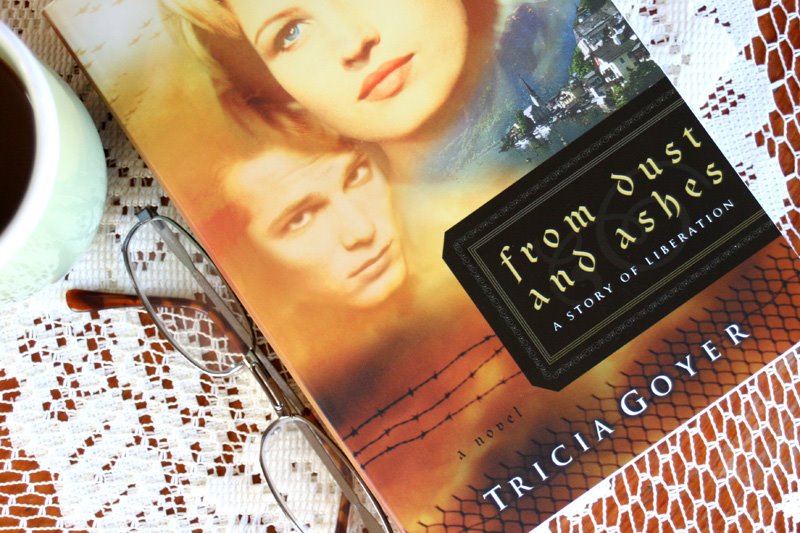
The Story Behind the Novel, From Dust and Ashes

I can clearly remember when my interest was sparked by the liberation events that took place in St. Georgen, Austria during World War II. An Austrian historian had invited me and my friends into her home, serving up tea and bread, meat and cheeses. It was the end of a long day of travel, and I secretly desired a hot shower and a soft bed. But it wasn't long before our host had me intrigued with her true tales of villains, prisoners, and GI heroes.

I sat--eyes wide--as Marta described the twenty-three, American GIs who had stumbled upon the Gusen camps May 5, 1945. I imagined their horror as they witnessed prisoners reduced to skin and bones. Or worse, piles of corpses. But Marta also spoke of other things, such as the first help to enter the camp--a young Nazi wife with her children on tow.

Who was she? I wondered. Obviously, she had not believed in the Nazi persecution. What would it have been like to helplessly witness such horror? How was her life forever changed?

I also imagined those prisoners who were mere days from death. How did they go on after facing such hatred, such loss? Just the night before, on a dinner cruise in Prague, I had sat elbow to elbow with a young Jewish girl and her brother.

"Fifty years ago, they would have been killed," my friend whispered in my ear as we talked and laughed with our new friends. It was then that the horrors of WWII became real, and I knew I would never be the same.

After we left Marta's house that night, I turned to traveling companions--also fiction writers. "Are you going to write about this?" At that moment their "nos" became my "yes."

I went home with much excitement and began researching the events concerning the liberation of Gusen and Mauthausen death camps. But I soon realized no articles or fuzzy, black and white photos could ever take the place of speaking with those who were actually there. So in August 2001, I was invited to attend the 59th reunion of the 11th Armored Division.

In Kalamazoo, Michigan, I spoke to the brave men, now in their 70's and 80's who had liberated the death camps. Their bodies have aged, but in their hearts they are still the same brave, young soldiers who witnessed so much.

As the research progressed, I was also able to visit Austria a second time to participate in the memorial services celebrating liberation so many years prior. And while there, I spoke with others, including a man who was just twelve-years-old in 1945. I was awed as he led me through the streets where former SS houses still stand. And tears formed in my eyes as I stood before the guesthouse of the brave, Nazi wife, now gone.

So fueled by memoirs, oral histories and personal interviews, I began to write. And in my mind, the streets of St. Georgen and the events of 1945 soon became as real as life around me.

On that sunny day in October, my greatest concern had been resting after a long day of travel. It was only later, after months of writing, that I realized God's intentions were far greater. His plan was to have me share a story of liberation. A story inspired by true events . . . and true heroes.

To read some of the true stories behind the novel, go to: http://www.triciagoyer.com/dustandashes/ and http://www.triciagoyer.com/ww2stories/

Tricia Goyer
www.triciagoyer.com

For more than a decade, author Tricia Goyer has drawn from her experiences as a teen mother and leader of today’s generation, to be a voice of hope and possibility for all teen girls, pregnant teens, mothers and wives. To learn more, visit: www.triciagoyer.com