Showing posts with label writing historicals. Show all posts

Wednesday, November 23, 2016

When Historical Characters Don't Do What You Want by Heather Day Gilbert


Sometimes our characters won't march easily onto the page. Today, author Heather Day Gilbert shares her experience with one of those characters. -- Sandy

Heather: There's a reason it took me three years to publish my second Viking historical novel, which is based heavily on the Icelandic sagas:

I couldn't change history.

The first novel in the series was easier—God's Daughter is based on Gudrid, a real Christian Viking woman who sailed to North America. She was known for her ability to get along with strangers, for her beauty, and for her strong Christianity.

But Book 2, Forest Child, was not based on Gudrid's story. It was based on her sister-in-law's story—Freydis, the daughter of Eirik the Red. Freydis was known for being a domineering woman, a violent warrior, and for being difficult to get along with.

Not to mention, she did something totally unthinkable. I had to merge the facts of her story into my fictional tale, AND I had to make her a character we wanted to root for.

It was a daunting task and I'll be the first to say that I stalled in writing the book, even though Freydis haunted me both in my dreams and waking hours. WHY did you do what you did, I would yell at her (mostly when I was alone in my car). My readers kept asking when Book 2 would release. Below is a pic of one of my most avid Viking readers, Kelly, when she finally got her early reader copy of Forest Child


I also write in first person present tense. So as I pondered Freydis' tale, I had to get into her head in a way I really didn't want to.

But something happened when I started writing her story. She came alive to me, even as Gudrid did, and I started to see her motivations. I started to understand what might drive a woman to do what she did.
I started to see her heart.

Sometimes, history doesn't turn out the way you want. For instance, I can think of several Bible stories that didn't play out in a cheery way. It's so sad that Moses never got to step foot in the Promised Land. It's hard to see Israelites being punished heavily for the same kinds of mistakes I know we would make.  It stinks that Solomon blotted his record of wisdom by marrying so many women and allowing them to worship other gods.

 But those stories are there for us to learn from.

For historical authors, we have to take real facts/details and merge them with a driving storyline that will bring history alive in a way that is fresh. We have some leeway in the interpretation of some facts (with the Viking era, the facts are few and far between—and still disputed), but in the end, especially if we're writing about real people, we have to be true to their stories. We have to let them make huge mistakes and do things we wish they hadn't done.

In the end, it was God who helped me bring Freydis' story to life in a way that was both relatable and redemptive. I fretted and worried my early readers might not "get" her...but it turns out, they're loving this book. And now they want to read more about Viking times. 

This is the ultimate reward for the historical author—when your novels spur readers to learn more about the time period you're so passionate about.

So be brave, historical author. Tell those tales that need to be told, spanning the years with characters that come alive for our readers.

Have you ever dealt with a character, historic or contemporary, who was hard to make likeable, but one you must write?


~~~~~~


HEATHER DAY GILBERT, a Grace Award winner and bestselling author, writes novels that capture life in all its messy, bittersweet, hope-filled glory. Find out more at heatherdaygilbert.com.

Monday, March 31, 2014

Rewrite, Rewrite, and Rewrite Some More! by Tanya Hanson


Tanya Hanson

Hey writers, have you ever stopped to think about all the elements we fiction writers are attempting to balance as we write? Rewriting helps us layer in what we may have missed that first or second pass. Our guest today discusses writing historicals, rewrites, and how "knowing" and "doing" are two different things. Read on! ~ Annette

Rewrite, Rewrite, and Rewrite Some More
by Tanya Hanson

I’m meeting more and more authors who work full time, raise kids and pets, volunteer and do church work, and still manage to write books. I’m incredulous because...

...in the past, I did all those things concurrently except write books. I put it off until my kids went off to college. But I told myself I was learning. Preparing for my future as an author.

You see, I taught writing and literature to high school students. With my kids snug in their dormitories, I was mega-confident. Hadn’t I learned everything about writing by teaching it?
Well, there’s writing, and then there’s romance writing. I learned the difference quickly after joining an RWA chapter. A romance editor will excise long, overwrought paragraphs of description, no matter how perfectly they’re written. Why? Readers tend to skip them. 

Readers want action—the push and pull of the hero and heroine falling in love and finding their faith, in spite of themselves.

So what do we romance writers do? Our characters have to live somewhere. Best advice—mix in details about the setting in the characters’ action and dialogue, rather than all at once like a travel brochure.

Same thing in historical romance. Nobody wants a long lecture about the past. I write historical Westerns. To set the time and place, I might show my cowboy-hero discussing with the sheriff some topics relevant to the Old West. Maybe women’s suffrage, a Civil War battle, or the latest rifle technology. He and the lawman could be searching the cowboy’s ranch for clues on cattle rustlers. Throughout their conversation, my hero imparts some of his backstory as well as some historical tidbits. And the reader gets a good—but quick—mental picture of the setting.

I can even add some intrigue. Maybe the sheriff is a fan of barbed wire closing up the open range and my hero is not. Hmmm. I’ve just foreshadowed a potential conflict.
Another hint: Romance writers show; they don’t tell. Those adverbs so beloved by my students now become actions. For instance, “I’ll never leave you,” he said tenderly becomes even better by showing. “I’ll never leave you.” He brushed his fingers across her cheek.

The romance reader needs to “feel” not just “read” what’s going on. The plain old He held her hand becomes much more personal as Her breath hitched when he took her hand.

To quote Elmore Leonard, “If it sounds like writing, rewrite it.” Even more so for those of us in romance. We want our readers to feel what our characters feel and not waste time or words getting there. Cutting and revising and editing hurts, but our stories are better for it.

Claiming His Heart


Learn more about Tanya here:


Tuesday, October 23, 2012

Writing about Tragedy: Voyage of the Titanic by Janice Hanna Thompson

My agent asked me to put together a story idea focused on the Titanic. I’m usually a comedic writer, (and he happened to catch me on my way home from the theater, where I direct musicals), so I quipped: “Only if I can throw in a song and dance number involving an iceberg!” He laughed and responded with, “No, we have to play this one straight.” At first I wasn’t sure if I could come up with a serious plotline, but 24-hours later I had the story idea and the first chapter. My editors at Summerside (Rachel Meisel and Susan Downs) read the idea and loved it. When they saw me at the ACFW conference I got the news: “We’re going to publish your novel!” I was especially thrilled to hear that my book would be among the first to release in the new line. What a privilege!

Writing historically accurate novels take a lot of research. I spend months researching Titanic’s story (reading every available book and watching every conceivable documentary), I also drove from Houston to Branson Missouri to the Titanic museum. Talk about an eye-opener! The exhibit covers everything you could imagine, and includes all sorts of artifacts from the ship. When you write about an event such as this, particularly one that has been so well documented in movies and books, you need to get your facts right. Even the “little” things (like, how long did it take to load everyone onto the ship) can bog the writer down. Dozens and dozens of times I would stop writing just to look something up. And don’t even get me started on the clothing and hats! I created a board on Pinterest to study 1910 fashion!

Why are people still interested in the Titanic? I think it’s the “unknown variable” that makes it all so interesting. It’s the fact that we can only speculate: Who were those people? What were they feeling? What were their hopes and dreams? What were they feeling before the ship set sail? After? How strongly did they feel it? Who did they feel it with? These are the questions that motivate us. As I sat to write this story, I envisioned people from every walk of life, all converged in one small world for a brief moment in history. Together, in that place, emotions surely ran the gamut (from exhilaration to distress and grief). Placing a love story in the middle of all of that emotion just made sense.

Several of my characters (primarily Tessa) face their own destiny. They come to grips with the brevity (and value) of life. They see first-hand what’s truly important and what isn’t. In my story, Tessa learns that her picture of God has been skewed (since childhood). She discovers a relationship with Him while onboard the ship, but that relationship is tested the night the ship goes down.

This year marked the 100th anniversary of the Titanic. It’s such a tragic story, and one that affected thousands of people. Meeting Cathy Peeling really put this in perspective for me. Her uncle passed away that night. This completely changed the make-up of her family. And she’s just one person out of thousands. Generations of people were affected by this tragedy. And so many feel a connection. Ship builders. Dress designers. Modern-day cruisers. The rich. The poor. The dreamers. Those who long to travel. We can all envision ourselves aboard Titanic on that fateful journey. Perhaps the greatest lesson to be learned from Titanic is this: We cannot put our trust/confidence in man-made things; only in the Lord.

Janice is passionate about her faith and does all she can to share the joy of the Lord with others, which is why she particularly enjoys writing. Her tagline, “Love, Laughter, and Happily Ever Afters!” sums up her take on life.

She lives in Spring, Texas, where she leads a rich life with her family, a host of writing friends, and two mischievous dachshunds. She does her best to keep the Lord at the center of it all. You can find out more about Janice at www.janiceathompson.com or www.freelancewritingcourses.com.

Book trailer for Janice's book about the Titanic, Queen of the Waves: http://www.youtube.com/watch?v=GlLeB8tiZbQ&feature=share

Monday, February 22, 2010

How I Research by Tricia Goyer

Please welcome Tricia Goyer as she discusses researching for historical novels. And though we've all learned something, how many of our writers of historicals have appreciated her visits this month on Manuscript Mondays? Thanks, Tricia!

How I Research
by Tricia Goyer

I don't know about you, but I spend twice as much time researching for my historical novels than even writing them.

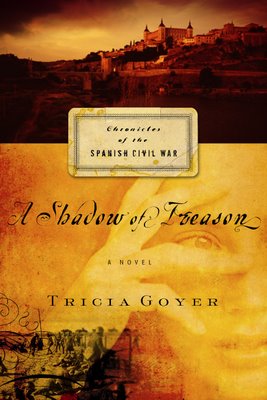
The first thing I do is work through Randy's Snowflake to get an idea of just what I'll need to research. For example, on A Shadow of Treason is about The Spanish Civil War. Before that, for Arms of Deliverance, I wrote about B-17 crews, female war correspondents, the Belgium underground, and Lebensborn homes.

After I Snowflake, I promptly go on-line and check out books available in my library system and books I need to purchase. I'll also do Internet searches on the subject, but I usually find much of my information in books.

Next, I created an Excel file for each of my characters and/or major subjects. They include the following headings:

Date, Action (what's taking place), Dialogue, Others (meaning interaction with others), Physical Description, Setting, Additional Research, Worse Possible Scenerio, Outcome.

I then read through my books and mark them with small post-its. I also highlight books I own. After that I enter these notes into my Excel databases. I've discovered the more I "handle" the information, the more I'm able to wrap my mind around it.

At this point, I use Writing the Breakout Novel by Donald Maass workbook to flesh out my characters and fine tune my plot.

In the previous two steps I'll even begin writing short scenes or bits of dialogue as they come to me so I don't lose them.

When that is done, I have a basic idea of the flow of my novel and even a very thin skeleton of scenes.

Finally, I start a file which is actually going to be my WIP. I alternate between writing the first chapters and moving the Excel notes over into the document. For example, if I know one of my first scenes opens with a B-17 getting attacked by German pursuits over occupied France, I'll create a section with B-17 descriptions, typical crew responses, etc.

Then, if I know the next section will introduce my female correspondent, I'll put my research notes for her next.

I keep doing this through the document in the basic outline of where I'll need the information.

(And I'm still not writing the book yet!)

It's at this point I also start looking for WWII vets or other historians to help me. For example, for B-17 crews, I figured out the exact Bomber group and squadron I needed for my WIP and then I searched for men in that squadron. Unbelievably most have websites and organizations, so I email the heads of that organization. The veterans are usually quite flattered that I've chosen them specifically, and many offer to answer questions.

I wait this far into my research before involving them, because I want to make sure to ask intelligent questions. I don't need to ask about crew duties, because I've found books to tell me that. Instead, I ask about specific missions, their emotional reactions, their personal experiences in London during liberty, etc. And they love helping!

Finally, I write the story.

I know that for some of you, this may seem like a crazy amount of research, but I adore it. Also, when I get to the point of writing, I write fast--like 80% of the manuscript in the month and 1/2 before it's due . . . which gives you a hint of what I'm doing this month!

Tricia Goyer

Check out all of Tricia's historical fiction

For more than a decade, author Tricia Goyer has drawn from her experiences as a teen mother and leader of today’s generation, to be a voice of hope and possibility for all teen girls, pregnant teens, mothers and wives. To learn more, visit: www.triciagoyer.com

Monday, February 15, 2010

Making the Past Understandable by Tricia Goyer

This Manuscript Monday, please welcome back author Tricia Goyer as she shares from her experience as a successful author of historical fiction.

Making the Past Understandable
by Tricia Goyer

As a writer of historical fiction, I like to consider myself a translator of sorts. It's my job to take the events of the past and make them understandable to today's reader. No ... more than that ... to make history come alive and make the past an enjoyable place to visit.

As a translator I must balance the core values and beliefs of a people in the past with the felt needs of today's reader.

If you write historical fiction you too are a translator. The question is ... how much will you compromise the past to connect today?

Compromise
The compromise doesn't mean changing the facts, but rather it means making sure our writing style and delivery appeals to today's reader.

Of course, we must also look at our "facts" and consider them from two different points of view.

For example, consider the Communists and Nazi regimes. The readers today, who have had even a basic history education, understand these two systems. Yet, how we see both is very different than someone who lived in countries influenced by both.

In my Spanish Civil War books I balanced the way communism was viewed by an unemployed American in 1936 with how readers look at it today. To a man in 1936, communism looked ideal. It gave a voice to common man and provided food and honor to men out of work. Still, I also created scenes that showed some of its many weaknesses—as known by today’s reader.

Resolution
Each author must come to his/her own resolution—"How much will I compromise to make my book interesting and exciting to today’s reader?"

Will you change?

  • Word choices?
  • Patterns of speech?
  • Lengthy descriptions?
  • Pace?

Personally, my resolution is to bring history to life. To make it as true-to-life as possible … but to write it in a way that will interest today’s reader.

  • I flavor my dialogue in a way that will not slow the story or confuse the reader.

I write in dramatic scenes and weave description into the flow.

Yet because I’m representing previous generations, I am also diligent in my research. I put in the extra time it takes to “get it right.”

In our market it's clear that the favored writing style of today’s reader mimics television/movies. Persia Woolley, author of How to Write and Sell Historical Fiction says:

“Television has created a visually oriented society, used to seeing things happen in the comfort of their own living rooms. The result is that those who still read are always, at least subconsciously, looking for a physical description of a person and place so they can see it in their minds’ eyes. Reading a book is such an internal process, it helps to give your audience a means of visualizing your characters and locations.” p. 102

That makes complete sense to me ... as a writer and a reader. Because we live in a different society than 100 or even 50 years ago, our books should look different too.

It's compromise, yes. We write about history, far different than historical books are written. But writing words to connect with a visually oriented society is also a way to connect the past with today's reader. Have at it, translator!

Tricia Goyer

Check out her WWII Liberator series

For more than a decade, author Tricia Goyer has drawn from her experiences as a teen mother and leader of today’s generation, to be a voice of hope and possibility for all teen girls, pregnant teens, mothers and wives. To learn more, visit: www.triciagoyer.com

Monday, February 1, 2010

The Story Behind the Novel by Tricia Goyer

Please welcome Tricia Goyer this month as she shares on writing historicals. She's a prolific author of so much more than historical fiction, but we're sure to learn a lot from her experience. Thanks, Tricia, for blessing our readers this Manuscript Monday.

The Story Behind the Novel

by Tricia Goyer

Hi! I'd like to start by introducing myself. My name is Tricia Goyer, and I'm the author of eight books, including four WWII novels. When I first starting writing, I never even considered writing historical novels (too much research!). I wrote articles, devotionals, and proposals for contemporary novels. And then, something changed all that . . . well, here's the story behind my first historical novel.

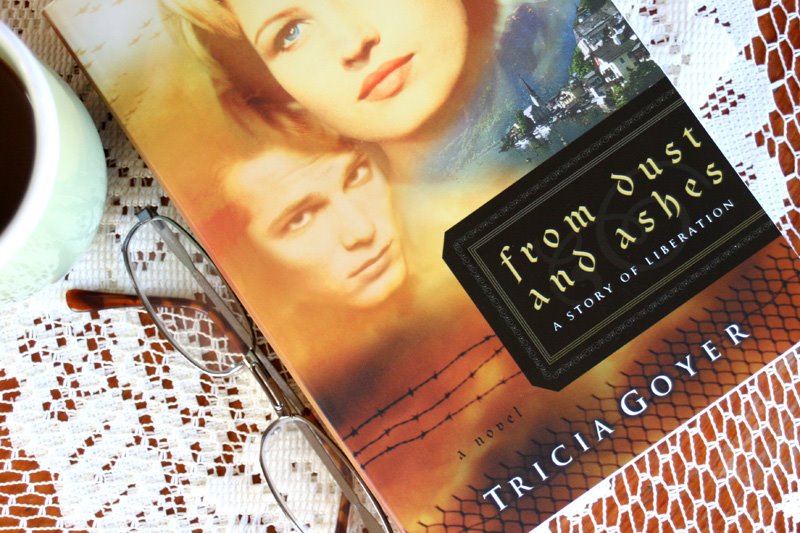
The Story Behind the Novel, From Dust and Ashes

I can clearly remember when my interest was sparked by the liberation events that took place in St. Georgen, Austria during World War II. An Austrian historian had invited me and my friends into her home, serving up tea and bread, meat and cheeses. It was the end of a long day of travel, and I secretly desired a hot shower and a soft bed. But it wasn't long before our host had me intrigued with her true tales of villains, prisoners, and GI heroes.

I sat--eyes wide--as Marta described the twenty-three, American GIs who had stumbled upon the Gusen camps May 5, 1945. I imagined their horror as they witnessed prisoners reduced to skin and bones. Or worse, piles of corpses. But Marta also spoke of other things, such as the first help to enter the camp--a young Nazi wife with her children on tow.

Who was she? I wondered. Obviously, she had not believed in the Nazi persecution. What would it have been like to helplessly witness such horror? How was her life forever changed?

I also imagined those prisoners who were mere days from death. How did they go on after facing such hatred, such loss? Just the night before, on a dinner cruise in Prague, I had sat elbow to elbow with a young Jewish girl and her brother.

"Fifty years ago, they would have been killed," my friend whispered in my ear as we talked and laughed with our new friends. It was then that the horrors of WWII became real, and I knew I would never be the same.

After we left Marta's house that night, I turned to traveling companions--also fiction writers. "Are you going to write about this?" At that moment their "nos" became my "yes."

I went home with much excitement and began researching the events concerning the liberation of Gusen and Mauthausen death camps. But I soon realized no articles or fuzzy, black and white photos could ever take the place of speaking with those who were actually there. So in August 2001, I was invited to attend the 59th reunion of the 11th Armored Division.

In Kalamazoo, Michigan, I spoke to the brave men, now in their 70's and 80's who had liberated the death camps. Their bodies have aged, but in their hearts they are still the same brave, young soldiers who witnessed so much.

As the research progressed, I was also able to visit Austria a second time to participate in the memorial services celebrating liberation so many years prior. And while there, I spoke with others, including a man who was just twelve-years-old in 1945. I was awed as he led me through the streets where former SS houses still stand. And tears formed in my eyes as I stood before the guesthouse of the brave, Nazi wife, now gone.

So fueled by memoirs, oral histories and personal interviews, I began to write. And in my mind, the streets of St. Georgen and the events of 1945 soon became as real as life around me.

On that sunny day in October, my greatest concern had been resting after a long day of travel. It was only later, after months of writing, that I realized God's intentions were far greater. His plan was to have me share a story of liberation. A story inspired by true events . . . and true heroes.

To read some of the true stories behind the novel, go to: http://www.triciagoyer.com/dustandashes/ and http://www.triciagoyer.com/ww2stories/

Tricia Goyer
www.triciagoyer.com

For more than a decade, author Tricia Goyer has drawn from her experiences as a teen mother and leader of today’s generation, to be a voice of hope and possibility for all teen girls, pregnant teens, mothers and wives. To learn more, visit: www.triciagoyer.com

Wednesday, December 16, 2009

Writing Historicals by Kim Vogel Sawyer

This Writer’s Journey Wednesday, I’m pleased to have guest Kim Vogel Sawyer share tips on writing historicals. Kim is an award winning author and friend. I’ve (Dawn) personally enjoyed her novels, and quite a few have found a home in my bookshelves. Enjoy her recommendations for writing in the historical genre.


Writing Historicals

One of my favorite ways to spend an afternoon is getting lost in a novel. Preferably a historical novel. As a little girl, I enjoyed visiting the past through reading a good story. When I grew up, I became a history teacher. I suppose, then, given my interest in history and reading historical stories it wasn’t much of a stretch that I would try to become an historical author.

One of the most important elements of any story is reality. Even though it’s a fiction story, plot lines that step beyond the bounds of believability can make a writer lost credibility in a reader’s eyes. So getting the facts straight—being historically accurate—is important. And that’s where research comes in to play.

When my fifth grade students researched for reports, I told them they needed to verify their information with three separate sources. As an author, I follow the same rule. Of course, kids loved to research on-line, and so do grown-ups! But just because you find something on a website doesn’t necessarily prove it’s correct—anyone can start a website. So using other sources is essential.

If possible, I like to visit college libraries in the area where my story is being set. They have wonderful reference sources and often have information specific to the area that you won’t find anywhere else. Librarians are a wonderful help if you need hard-to-find information. I have yet to find a resource librarian that wasn’t willing to help me dig for details.

Building a private library is advisable—especially if your stories tend to focus within a specific time period or area. Having your own books lets you mark important passages, fold down corners, or whatever else helps you study. Librarians usually frown if you mark up their books. :o) Since I write predominantly late 1800s-in-Kansas stories, most of my books are committed to Kansas in the 19th century. I write some Mennonite stories, so I also have Mennonite history books. Over the past years, I’ve collected textbooks from 1911 through the 1950s—not only do these books give historical information, they usually have photographs and they’re written in a language that “sounds” like the time period, helping me step into character.

Books are fantastic, but nothing beats a personal visit to get a “feel” for the area. Every area has its own landscape, vegetation, and typical weather patterns. Experiencing these things for yourself can help you understand what your characters lived.

So carefully research. Then share the information—as a natural extension of the story—so the setting comes alive for your readers.


Bestselling, award-winning author Kim Vogel Sawyer is a small-town Kansas girl living out her childhood fantasies of becoming a writer. Kim's stories contain faith lessons her readers can adopt into their personal lives. She and her husband are empty-nesters with three adults daughters and six grandchildren. Learn more at http://www.kimvogelsawyer.com/