Friday, August 10, 2012

Jesus and Mama Always Loved Me by Julie L. Cannon


Writers will sometimes use music to help set the mood of the scene they’re working on. I grew up enjoying a variety of music styles, but didn't come to appreciate country until a few years ago. This Fortifying Friday, author Julie L. Cannon shares how her own love of country music influenced her writing and journey to publication. Enjoy!   
~ Dawn
   

Jesus and Mama Always Loved Me
by Julie L. Cannon

Even when the devil took control – Confederate Railroad. I love stories and I love country music because it tells stories, and if I had to pick a theme song for my stories, it would be that one. When I was in Nashville doing research for my novel, Twang, I read a quote by Conway Twitty that said, “A good country song takes a page out of someone’s life, and puts it to music.” I believe the same is true for a good novel.

Don’t ask me why I put “Jesus and Mama Always Loved Me” on my I-pod, because neighbors probably think I’ve got a screw loose as they watch me walking along Dogwood Hill, literally sloshing through puddles of my own tears. I’ve listened to this song (story) a zillion times and it never fails to come alive for me in vivid Technicolor every single time I hear it. As the song begins, the protagonist may be a male teenager, but I am him. I feel his yearnings, his lust, his pain and his subsequent remorse, then his wonder that someone could still love him despite everything. My heart knows the veracity lacing those lyrics, especially the chorus. He and I both strayed, and yet, when more than the usual feeble human love was needed, there came a surge of supranormal love—the kind you get only from Jesus and Mama.

I burst out into this world in 1962, and I grew up down South, a land of red clay where it’s not uncommon to see roadside signs reading ‘Jesus and Tomatoes Coming Soon.’ My folks carried me to church every time the doors were open, but I’m afraid the gospel did not take a hold. I did not follow the narrow path. I went from fun to fun, not caring about a thing in this world but Julie. I didn’t steal a car like the fellow in the song did, but boy did I walk the wide road, and it took great tragedy, several in fact, for me to hit that proverbial rock bottom (you can read about this in more detail on my website under Blogs). When I did, it was a transcendent love that lifted me. A love I endeavor to write about in each of my novels.

I think the key to making a story come alive is being willing to rip a page from your own life. Donald Maass, writing guru, puts it like this; “These novels change us because their authors are willing to draw upon their deepest selves without flinching. They hold nothing back.”

When I began writing Twang, I wanted to show how a wounded country music diva can use her pain to create powerful songs that touch others’ lives. Not only do they change Jenny Cloud’s audience, but they change her as well. I wanted to show how God can redeem the seemingly unredeemable—the way He did in my life. If you like spiritually daring stories, I hope you’ll check out Twang.
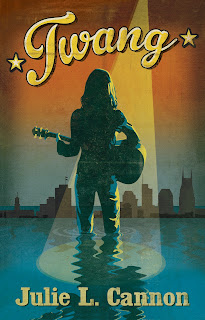


Click to reach Amazon.
Julie L. Cannon is the author of the award-winning Homegrown series, published by Simon & Schuster and described as ‘Southern-fried soul food.’ Her novel I’ll Be Home for Christmas, Summerside Press, Sept. ‘10, made the CBA Bestseller List as well as Nielsen’s Top 50 Inspirational Titles. Abingdon Press will release Twang in August 2012, and Scarlett Says in October 2013. When she isn’t busy tending her tomato patch, Julie can be found listening to country music or teaching memoir-writing workshops. She lives in Watkinsville, Georgia. Visit her website at www.julielcannon.com and connect with her on Facebook at www.facebook.com/julieLcannon and on Twitter at JulieLCannon. 

Thursday, August 9, 2012

Predictable No More


Has anyone ever described your work in progress as predictable? Not words you want to hear! Critique groups are great places to squash that ugly thing. Here are some strategies that have worked for me. 

First, Brainstorm
            Here’s a step-by-step refresher of how it works.
1.      Grab something to write on. A white board works great, but paper will do.
2.      Gather your most creative friends. The bigger the group the better, but two also works. In a pinch, you can even fly solo, but it’s not as much fun.
3.      Define the problem/topic. Make sure everyone knows just what issue they are trying to solve.
4.      Go nuts! No scenario’s too fanciful. No idea’s too farfetched. No twist too twisted. When I said, “I know—he’s a communist!” my critique partner tilted her head with a grin and said, “Write it down.”
           
Have you ever heard the saying, “If you throw enough mud against the wall, some of it will stick?” That’s the idea with brainstorming. On a page packed with throw-away ideas (like the communist one), I usually come up with one or two winners.

The “What If” Game
Try a fast-paced game of “What If.” Start randomly.
“What if the stock market crashes?”
“What if a tsunami strikes?”
“What if the main character is pregnant?”
Then build on each other’s ideas.
“And her husband doesn’t know.”
“Or the husband knows, but she doesn’t know.”
“Or they both know, but don’t want to tell the other…”
Get the idea?
This fuels imaginations (lights them on fire, really!) and will likely produce several nifty nuggets.

Think the Opposite
Pick an event, predict the outcome, then ask, “What’s the opposite?” It energizes the romantic aspect particularly. The girl pines over the guy, loves him from afar. He finally confesses his love. What do you expect? She falls adoringly into his arms, right? But what’s the opposite? She spits in his face and runs away. Do you see how powerful this is?
It also helps with character development. The protagonist is a strong, working woman. When confronted with an overwhelming situation, the reader expects her to handle it. What’s the opposite? She crumbles in tears, or runs away, or falls into an uncontrollable fit of anger.
Just thinking this way can root out predictability. The reason it works is because we’re all plagued with inner conflict. When our characters are too consistent, it makes them seem stale and contrived—so flip ‘em around. Make them surprise themselves—and you.

Conflict on Every Page
Finally, examine how to dump more stress on your poor, naïve characters. Why should life be so easy for them anyway? Start by focusing on a few plot points, asking, “How can I make this more difficult?” One character was traveling on a ship. We couldn’t let her simply float to her destination. No way. “I'll sink the boat,” I plotted, wiggling my fingers fiendishly. “Or have engine trouble, or slam into a whale.”
Later, go back and do this with each plot point. What a difference. I was surprised at how nice I had been to my characters. What was I thinking? Nice? Ha!

            By the time you finish these steps, you'll have some great ideas to play with. So next time, there’ll be no use of that nasty “predictable” word. 


Wednesday, August 8, 2012

How Do I Write Meaty Scenes? Part One


Happy Wednesday, my writing friends!

When I first started writing, I added scenes just to enhance my story’s aura. If a character went to a party, for example, I’d describe the food and the people, show the character’s reactions. Then she’d leave the party.

But nothing really happened!

Having written and edited for a while now, I’ve learned how deadly this is. Each scene must brim with juicy meat or hungry readers will hunt elsewhere for something to gnaw on.

How do we beef up our scenes? Here are two do's that work for me. (Next week: one more do and a don't.)

Do Be Relevant
First and foremost, every single scene must exist for a reason. In a book I'm reading, the main character decides to take a stroll on the beach. Uh oh, I think. Here comes a long, irrelevant string of introspection. My thumb perches on my Kindle to skim past the boring part, but, to my delight, a weird dude accosts the character, and then, even better, the hero shows up. My thumb relaxes, and I stay focused on the story. Stuff's happening, and I want to go along for the ride. 

I always ask myself, “What is this scene’s job?” If it doesn’t accomplish anything—bye bye!

Do Create Conflict (Internal and External)
If it were up to me, both internal and external would pulse through every scene. Why? Let’s say we have a ton of external conflict—a bus roars at our hero. That’s good conflict, right? How much better if the driver of the bus is our hero’s wife? Now, not only does he have a bus to contend with, but emotions associated with betrayal, loss, and love. 

Also, if a scene consists of internal conflict only, we risk boring our audience. That’s a pretty big risk. If a story requires a scene with only internal angst (and sometimes it does), follow these rules of thumb: 1. Make sure the angst deeply affects the plot, 2. Keep it short—not many folks can handle long, drawn-out soul searching, 3. Use deep POV so readers can feel what the character’s feeling.

So this week as you're beefing up your manuscripts, keep these tips in mind. And tune in next week for more. 

What do you do to add meat to your scenes? I'd love to hear! 

And don't forget to leave your questions for Ask O Wednesdays here in the comments. 

God bless and happy writing, 
Ocieanna

Tuesday, August 7, 2012

Why Do We Doubt God? by Lisa Jordan

Several months ago, I had to renew my family childcare provider license. I set it aside because I was in the middle of final edits for Lakeside Family, which released this month, child assessments and preparing for an upcoming writers retreat.

Then I received a 30-day renewal reminder. I dug out the paperwork, filled out the application, had the required physical and had my son's clearances done.

Once I received his clearances, I could mail everything. The days slipped off the calendar at an alarming rate. I kept asking my son if he received the clearances in the mail.

"Nooo, Mooooom."

Moms of teenagers, I'm sure you can hear it in your head. Then he realized I wasn’t talking about something for college, but for my business. He had received it, but couldn’t find it in the abyss of his bedroom. He started cleaning right away, but I needed a miracle.

I prayed and asked my writing support team to pray.

I had 7 days. Without my renewed license, my business—our primary bread and butter at the time—would close. My stress level was through the roof.

Then, I came to the realization—would closing my business be so terrible? I could work part-time and write a lot more than I do now. God must have a reason for all of this, right?

Maybe I needed to understand He could be sending me down a new path. Maybe I needed to be better organized.

Maybe I simply needed to trust.

I surrendered my fears and anxiety to Him. Whatever happened, I would embrace and move forward.

I mailed what I had with a note explaining the duplicate clearances had been mailed. After receiving my application, my rep called to say she was giving me an extension since she knew the documents were on their way. When I received them, I needed to fax her a copy.

I received the clearances in record time, faxed and mailed copies, and received my new license by the original date. No extension needed.

Why? All because of God.

When I opened the envelope containing my license, I laughed.

Why did I doubt God?

He always answers our prayers, but sometimes we may not like hearing Him say no. No means change. No means pain. No means uncertainty for the future.

Jeremiah 29:11-13 promises "For I know the plans I have for you,” declares the Lord, “plans to prosper you and not to harm you, plans to give you hope and a future. Then you will call on me and come and pray to me, and I will listen to you. You will seek me and find me when you seek me with all your heart."

What an incredible Life Compass. Even if we have change in our lives, we're not walking toward it alone.

Your turn: Share a time in your life where God provided or pulled you through a situation in a way only He could.

Married 23 years to her real life hero, Lisa Jordan knows a thing or two about romance. She and her husband have two college-aged sons and will be facing an empty nest soon. By day, Lisa is an early childhood educator, and by night, she is a contemporary romance novelist with Love Inspired. Lakeside Reunion, her debut novel, is a 2012 Carol Award Finalist. Lakeside Family, her second novel, releases in August 2012. She is represented by Rachelle Gardner of Books & Such Agency. In her free time (ha!), Lisa enjoys good books, chick flicks, crafting with friends and feeding her NCIS addiction. To learn more about Lisa, visit her website at www.lisajordanbooks.com.

Lisa is celebrating Lakeside Family with a month-long party of giveaways, including Coffee Lovers and Tea Lovers baskets. For more details and to join her party, click here.